Back to ResourcesSoftware guide

Landscaping Business Software: What Helps Once the Work Gets More Complex

How to compare landscaping software when jobs carry more scope, more crew coordination, and more commercial detail than a simple maintenance round.

At a glance

  • Landscaping teams need stronger quote-to-job handover and clearer site context than many generic service apps provide.
  • The right system should cope with repeat maintenance and one-off project work in the same model.
  • Buying decisions should focus on coordination, change handling, and commercial control, not just calendars.

Why landscaping work outgrows simple tools faster

Landscaping businesses usually hit complexity earlier because one system has to support site-specific work, changing scope, crew coordination, and more expensive quoting decisions.

If those pieces sit in separate tools, the office ends up translating the job back together every time it changes.

The strongest software decisions are usually the ones made around workflow quality rather than feature volume.

A product that is slightly narrower but much clearer often saves more time than one with a longer sales page and a weaker operating model underneath it.

That matters even more in gardening and landscaping because so much of the work is repeat-based.

Small bits of friction get repeated dozens of times a week, which is why loose admin compounds so quickly once the round gets busy.

Why category fit matters

This is also where category fit matters.

A generic field service app may technically handle jobs and invoices, but still feel clumsy if it does not understand repeat maintenance, multiple sites per client, or the level of context a crew actually needs before arriving on-site.

The goal is not to buy the most advanced product on paper.

It is to buy the product that lets the business run a normal week with less retyping, fewer side conversations, and a stronger link between what was sold, what was scheduled, and what was delivered.

The workflows worth testing first

Focus on the journey from quote to scheduled work, then from scheduled work to clean close-out and billing.

A product that only handles one stage well often leaves the business with extra admin exactly where the job becomes commercially risky.

The most revealing comparison usually happens when you stop asking whether the product technically has a feature and start asking how many clicks, workarounds, and side conversations it takes to use it well.

Good software feels calm under normal weekly pressure, not just impressive during a demo.

It is worth involving both the office view and the field view in that test.

A tool can look strong to the person building the schedule but still fail the team if the mobile record is thin, the notes are hard to find, or updates are awkward to send back.

Test the awkward moments, not the polished ones

Another useful question is how the product behaves when something changes after the original plan.

You learn much more from moving one visit, repricing one extra, or reassigning one job than from creating a perfect example that never has to react to reality.

It is also worth looking beyond the first month.

A product can be easy to set up but still weak at scale if recurring work becomes hard to review, historical jobs are awkward to reference, or completed work never flows cleanly into billing and reporting.

  • Run one real client-to-invoice workflow, not just a feature tour.
  • Check both the office workflow and the mobile job experience.
  • Look for the places where notes, extra work, and schedule changes become awkward.

Why Fieldfare

See how Fieldfare handles jobs, crews, and billing together

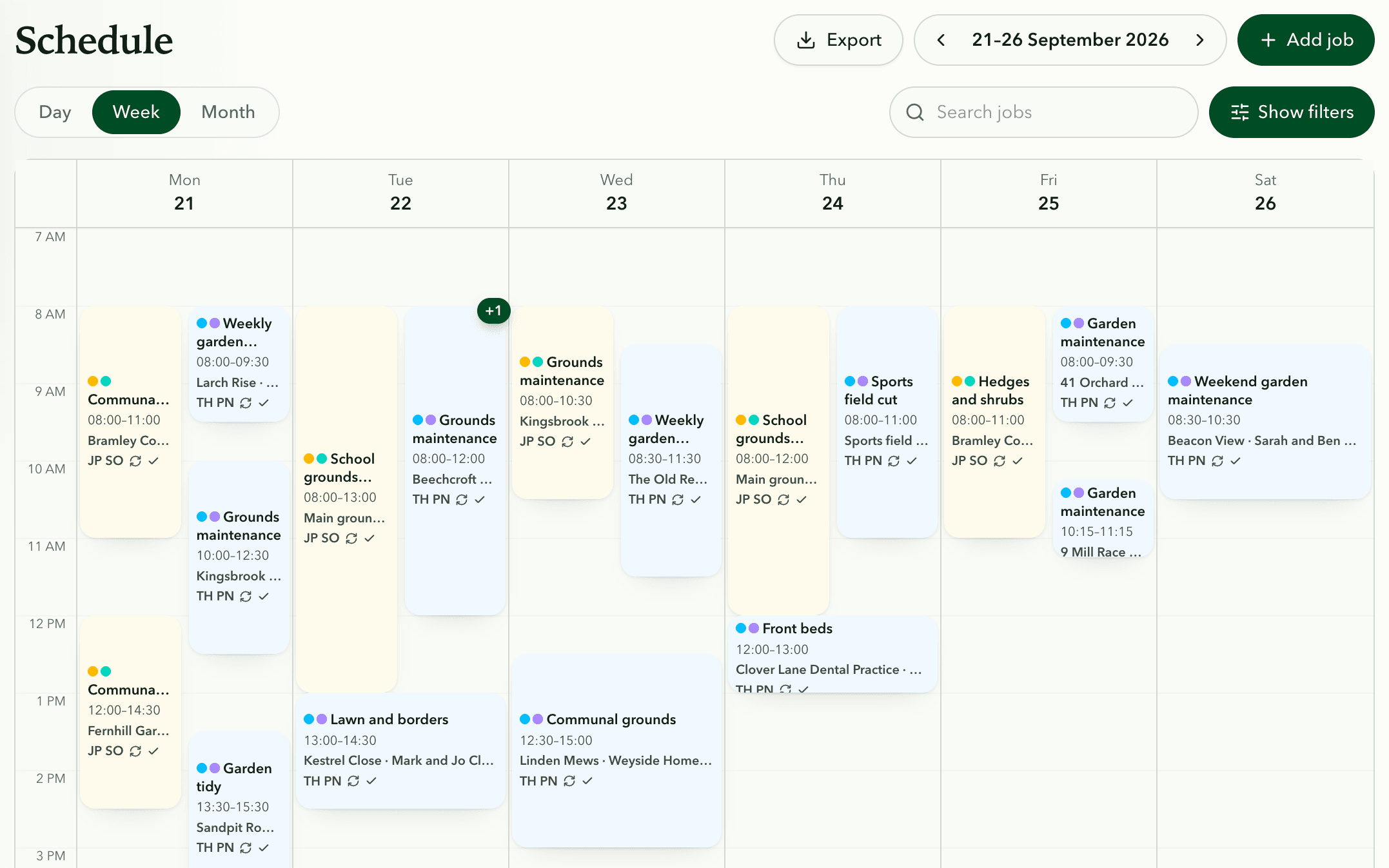
Fieldfare gives landscaping teams one place to manage sites, quotes, live jobs, recurring work, and field updates without the usual handover mess.

What the data model needs to support

Landscaping software should understand client, site, job, crew, and commercial detail as related records, not as isolated lists.

That matters when dates move, scope changes, or another team member has to step into a job without asking the office to explain everything again.

In practice, that means the system should help with the real handovers that happen every day.

The office should be able to quote work, schedule it, attach the right notes, and trust that the field team will see the same picture without another round of texts or phone calls.

It also means the record should stay useful after the first setup.

If every schedule change, extra visit, or invoice still depends on somebody remembering the backstory, the software is acting more like storage than as an operating system for the business.

What good connected software feels like

A lot of products claim to be 'all in one', but the useful test is whether the same record survives from first enquiry to final invoice without being flattened into a vague job title halfway through.

If the site detail, scope, photos, and access notes disappear as soon as the work is scheduled, the system is still creating hidden admin for the business.

For UK gardening and landscaping teams, this matters because the real work is often repeat-based and site-specific.

One missed note about parking, waste, gate access, or visit timing may look minor in isolation, but when those misses repeat across the week they damage margin, service quality, and customer trust at the same time.

How to judge fit properly

Run one real landscaping workflow through the product: add a site, quote the work, assign the team, attach the important notes, and imagine invoicing it later.

If that path feels obvious, you are looking at a serious contender; if it feels like a workaround, it will only get worse when the business gets busier.

The most revealing comparison usually happens when you stop asking whether the product technically has a feature and start asking how many clicks, workarounds, and side conversations it takes to use it well.

Good software feels calm under normal weekly pressure, not just impressive during a demo.

It is worth involving both the office view and the field view in that test.

A tool can look strong to the person building the schedule but still fail the team if the mobile record is thin, the notes are hard to find, or updates are awkward to send back.

Test the awkward moments, not the polished ones

Another useful question is how the product behaves when something changes after the original plan.

You learn much more from moving one visit, repricing one extra, or reassigning one job than from creating a perfect example that never has to react to reality.

It is also worth looking beyond the first month.

A product can be easy to set up but still weak at scale if recurring work becomes hard to review, historical jobs are awkward to reference, or completed work never flows cleanly into billing and reporting.

  • Run one real client-to-invoice workflow, not just a feature tour.
  • Check both the office workflow and the mobile job experience.
  • Look for the places where notes, extra work, and schedule changes become awkward.

Common questions about landscaping business software

How should you compare software properly? Run one ordinary client, one site, one recurring visit, one extra quote, and one invoice through the product.

That tells you much more than a generic feature list ever will.

What usually gets missed in a software trial? The field workflow.

Teams often test the office calendar and the invoicing screens, but forget to check whether the mobile job view is actually good enough for someone arriving on-site with limited context.

How long should you trial a product before deciding? Long enough to run a believable slice of the real workflow, including at least one schedule change or scope change.

Static examples almost always flatter the tool.

Why Fieldfare

See how Fieldfare handles jobs, crews, and billing together

Fieldfare gives landscaping teams one place to manage sites, quotes, live jobs, recurring work, and field updates without the usual handover mess.