
In short
- Give each day (or each van) one area and offer new clients the day you are nearby.
- Check postcodes and job durations before you look at the map.
- Look at the real week on a map once a fortnight and move the clients who pull you across town.
Give each day one area
Monday is the north of town, Tuesday the villages east of the bypass, and so on. If you run more than one van, give each van its own area.
When a new enquiry comes in, look at which day you're already in their street or village and offer that day first.
Check postcodes and timings first
Before you look at the map, check:
- Every site has a correct postcode.
- Every regular job is booked for the time it takes in practice. The two-hour garden that takes three pushes back every stop after it.
- Loading, the tip run and lunch are counted. Leaving them out is why a day that finishes at three on paper finishes at six.
- Skills are matched. If only one person holds the spraying certificate, their jobs go on the days they work, even if the drive is a bit longer.
Look at the day on a map
Route optimisers don't know about the lane by the ford that floods every February, or the client who wants you gone before her bridge club at two. You need the week laid out where you can see it, and then you set the order yourself.
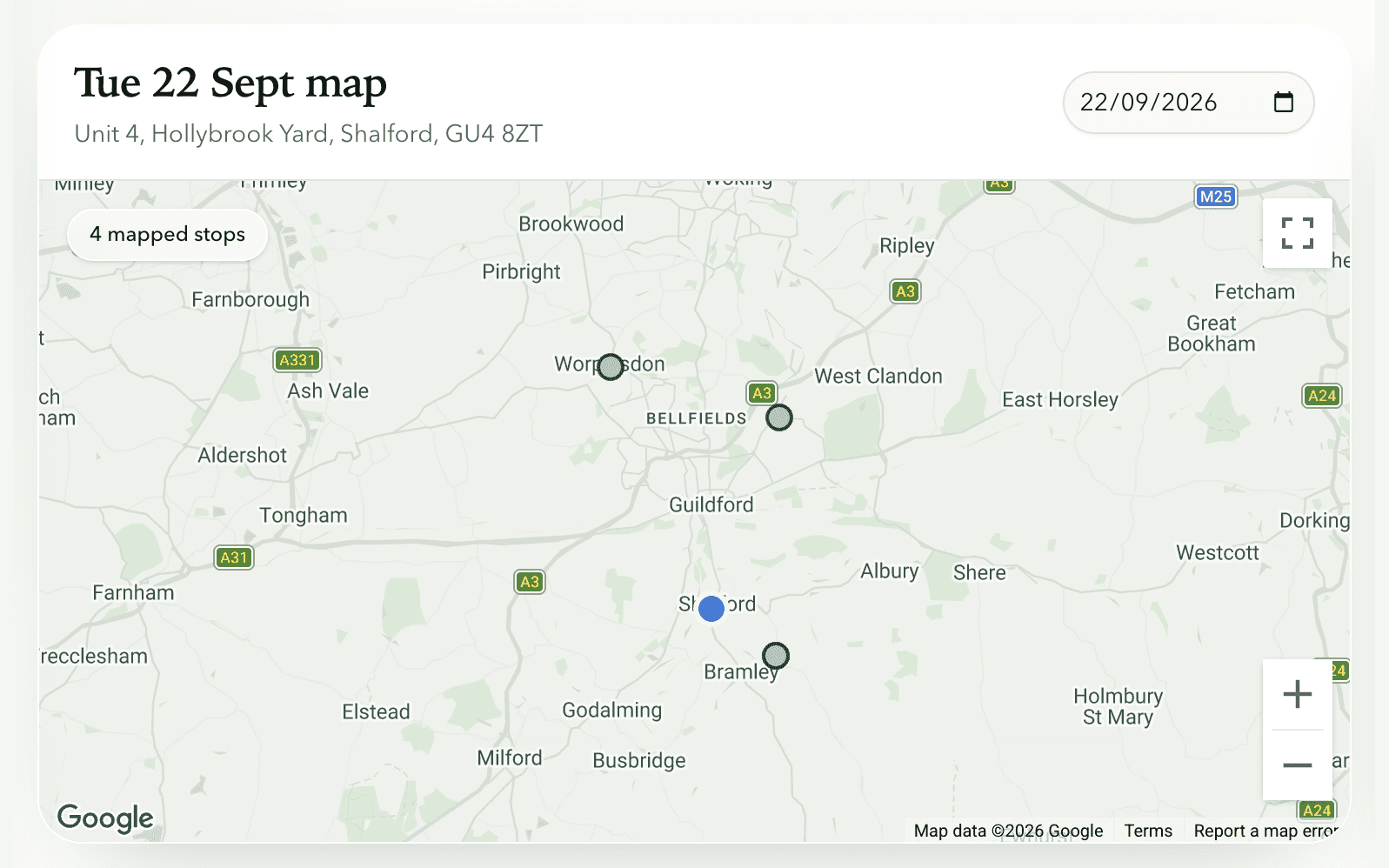
Fieldfare puts the day's jobs on a map along with where each member of staff is heading. If Thursday has one job stranded out past the bypass, it stands out straight away, and you drag it onto Tuesday in the week view.
Fieldfare
Put the day's jobs on a map
Leave a gap for the rain
A day packed to the minute breaks the first time a job overruns. Keep part of one day, often Friday, free for rain delays and overruns. If it isn't needed, fill it with one-off work or van maintenance.
Give clients a morning or afternoon rather than 10:15. Staff can absorb small delays without letting everyone after them down.
Check the map every couple of weeks
Every couple of weeks, look at days that have already happened rather than the plan. Things to look for:
- Clients outside every regular route.
- Visits on the wrong day for their area.
- Days that always finish late, and what they have in common.
- Small one-off jobs that could sit next to a regular visit.
Route planning questions
Does each day need to be a loop?
No. Staying in one area matters more than ending where you started.
What if a client wants a day outside their area?
Offer the day you are nearby first. If they need another day, add a travel charge, because that visit costs more to deliver. Our pricing guide covers travel supplements.
Does Fieldfare plan the route for me?
No, it doesn't reorder the stops. It shows the day's jobs and where your staff are heading on one map, you decide the order, and moving a stray job to another day is a drag in the week view.
How often should routes be reviewed?
Glance at the map weekly, and do a proper review before spring and after summer when the mix of work changes.